Birth to Year of Renunciation (0–17 years)
Dawn of a Spiritual Journey
A Sacred Arrival
It was a quiet winter night—3rd March 1896, Fagan Vad 4, a date sacred in Jainism as the occasion of Shri Parshwanath Bhagwan’s Chaiyavan and Kevalgyan Kalyanak.
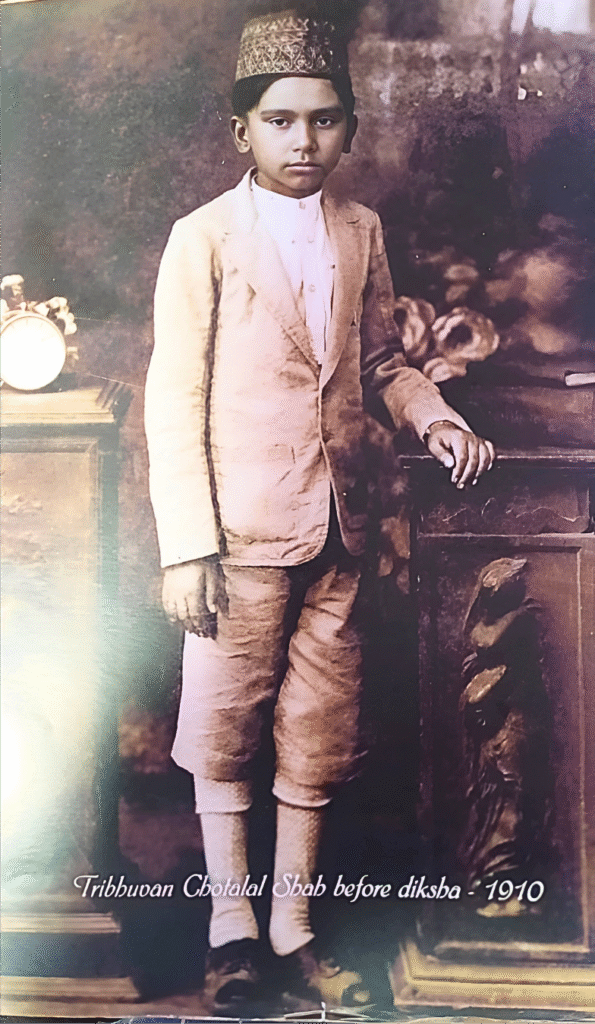
In the village of Dehwan, near Khambhat—then shadowed by a deadly plague—a fragile yet radiant soul took birth. The newborn was named Tribhuvan, lovingly called Sabudo by his family. He was born into the Shah family, destined for greatness.
But joy quickly turned to sorrow. At just 40 days old, he lost his father, Chhotalal Raichand, to the plague. Within months, the epidemic consumed nearly 150 relatives, leaving the family lineage nearly erased. In the heart of this loss, one unshakable figure remained—Ratanba, his great-grandmother. With boundless faith and love, she raised young Tribhuvan as her own.
Signs of the Saint in a Child
From early childhood, Tribhuvan displayed a remarkable sense of detachment and discipline far beyond his years. At the age of three, he began drinking only boiled water—a vow of purity that even most adults found difficult to keep. He refused to eat after sunset. Ratanba would wake him before dawn for pratikraman and patiently teach him Jain verses. In time, he went on to memorise the Nav Tattva, Jiv Vichar, and Samkit 67 Bol Sajjay with remarkable ease Even at this tender age, he attempted to leave home for spiritual renunciation, once walking miles barefoot before being brought back. His resolve was already forming.
At age 7, Tribhuvan lost his mother, Samrath Devi, to a second wave of the plague. Grief-stricken, he was soon afflicted by a painful eye infection. One feverish night, he dreamt of his mother descending from the heavens, softly placing her hand on his eyes.
By dawn, the pain had vanished. Miraculously, his eyesight remained perfect for the next 90 years—so sharp that even in old age, he could read the tiniest Jain scriptures. He would often say:
“It was my mother’s blessing, so I may read and teach the word of Mahavir.”
Withdrawn from the World
By age 9, Tribhuvan left conventional schooling and fully immersed himself in spiritual studies. He showed no interest in wealth, toys, or indulgences.
At age 10, he gave up his favorite sweet—ghebar—to strengthen his vow of detachment. Whenever monks visited nearby villages, he would quietly leave home to sit in their satsang, absorbing every word. His family often found him seated among monks, asking questions far beyond his age. By his early teens, he was already explaining complex Jain doctrines to new sadhvis—as if he had walked the path many lifetimes before.
The Sacred Call to Diksha
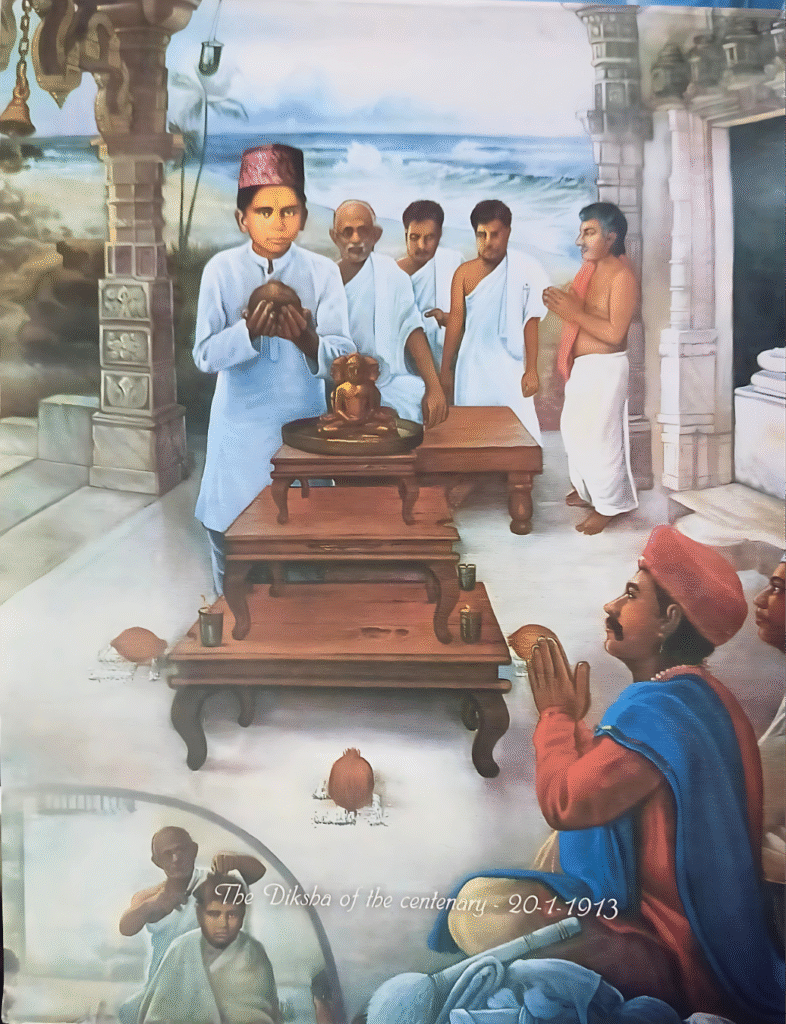
On the auspicious day of 20 January 1913, Posh Sud Teras, the divine moment finally arrived. At the ancient Gandhaar Tirth, the temple resonated with the sounds of nature—cuckoo calls, crashing waves, and chirping birds—as if the universe prepared a grand welcome. In the temple’s ornate rangmandap, a symbolic samovasaran had been created. There, Tribhuvan stood—coconut in hand, eyes aglow with surrender, as an earthen lamp flickered before the idol of Lord Amijhara pashwanath. The pujari froze, overcome by the spiritual energy radiating from the boy. His journey as a householder had ended; his soul had finally reached its calling.
The Sacred Ceremony at Gandhaar
As the diksha ceremony began, faithful shravaks Jamnadas Kothari and Chimanlalji arrived breathless, carrying the essential upkarans across towns. Muni Shri Mangalvijayji Maharaj received them with divine relief. As the sacred ogho was handed to young Tribhuvan, his face lit up with fervent joy. Overwhelmed, he danced around the samovasaran, soaked in devotion. When the moment came for the symbolic shaving of his hair, the local barber was missing. Without delay, Muni Shri Mangalvijayji Maharaj began the process himself. The barber arrived midway to assist, and finally, with sacred symbolism, Maharaj plucked the last few strands by hand—marking the ultimate surrender.
Become a Volunteer
Step into the path of selfless service inspired by Param Pujya Gurudev Shrimad Vijay Ramchandrasuriji Maharaj, whose life was a beacon of truth, penance, and devotion to Jain Dharma. By volunteering, you become part of his enduring legacy—contributing to spiritual growth, community welfare, and the spread of values that uplift humanity. Join us in carrying forward his mission of enlightenment, compassion, and service to the Jain Sangh and beyond.